Towel rail not getting hot? Causes and fixes
A towel rail not getting hot is usually trapped air, a closed valve or poor balancing. How to check each one and how to bleed a towel rail safely.
A towel rail not getting hot is usually caused by trapped air, a valve that has been turned off, or a heating system that sends most of its hot water to other radiators first. All three can often be sorted in under an hour, and two of them you can check yourself today.
Start by turning the heating on and waiting 20 minutes. Then feel the rail from top to bottom and check the rest of the house. What you find tells you where to look.
Why is my towel rail not getting hot?
| What you notice | Most likely cause |
|---|---|
| Cold at the top, warm at the bottom | Trapped air |
| Cold all over, other radiators hot | Valve closed or rail not getting flow |
| Lukewarm, takes ages to warm up | Poor balancing, or sludge |
| Cold at the bottom, warm at the top | Sludge settling in the rail |
| Only hot when hot water is on | Rail is plumbed to the hot water circuit |
| Electric element works, heating does not | Valve or flow problem on the heating side |
1. Trapped air: bleeding a towel rail
Towel rails are often the highest point on a bathroom circuit, so air collects in them. Bleeding a towel rail works much like bleeding a radiator, but the bleed valve is at the top corner, sometimes hidden on the side or under a cap.
- Turn the heating off and let the rail cool for about 30 minutes. Hot water can scald.
- Find the bleed valve at the top of the rail. You will need a radiator key or, on some rails, a flat screwdriver.
- Hold a cloth under it and turn the key slowly anticlockwise, about a quarter turn.
- Listen for hissing. That is air escaping. When water starts to come out steadily, close the valve.
- Check the boiler pressure. On a combi or sealed system it will have dropped a little. Top it up to about 1 to 1.5 bar using our guide to repressurising a combi boiler.
- Turn the heating back on and check the rail after 20 minutes.
If the rail needs bleeding every few weeks, air is getting in somewhere or gas is forming from corrosion inside the system. That is worth having looked at rather than bleeding forever.
2. Valves closed or stuck
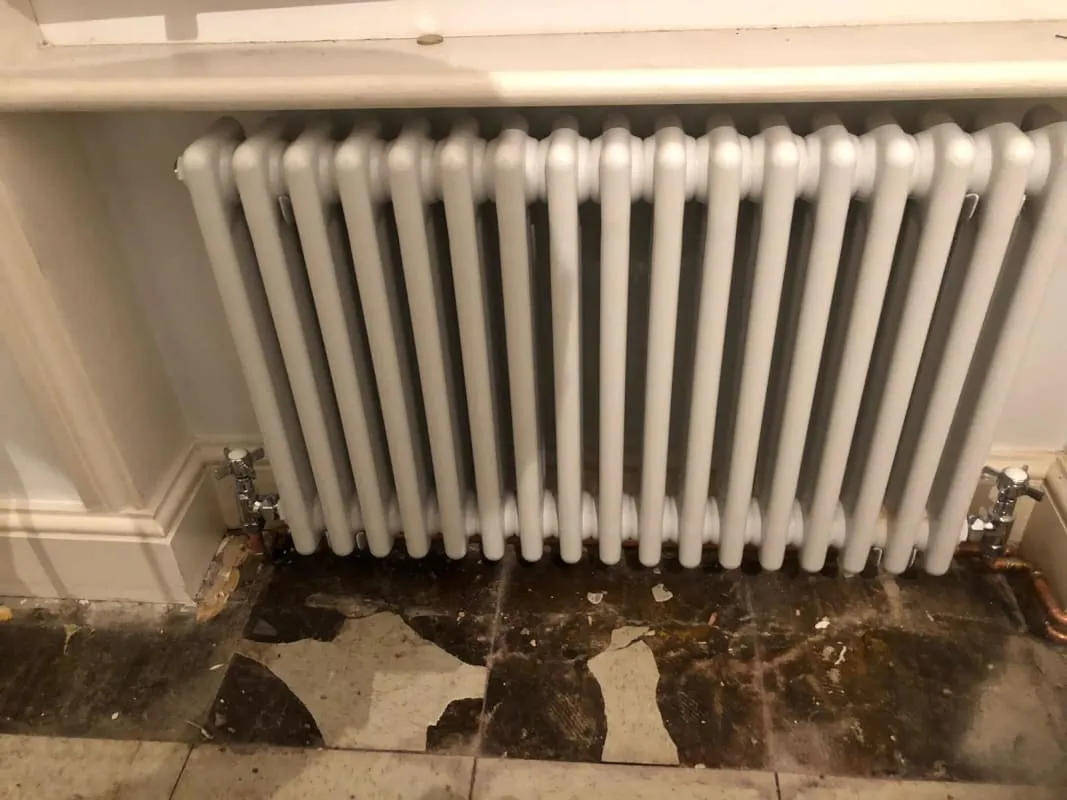
Towel rails have two valves at the bottom: one controls the flow and one, the lockshield, sets the balance. After decorating or a new bathroom, one or both are often left closed.
- If one valve is a thermostatic head (TRV), turn it up to the highest number.
- If it has a plain cap, turn it anticlockwise to open.
- The lockshield is under a plastic cap. Do not turn it right down; if someone has closed it, opening it a turn or two is usually enough.
TRV pins can also stick in the closed position, especially after summer. Take the head off and check whether the small pin underneath moves in and out. Our post on thermostatic radiator valves explains how.
3. Balancing: the rail is last in the queue
Hot water takes the easiest route. In many homes the bathroom is at the far end of the circuit, so the radiators nearer the boiler take the heat and the towel rail gets the leftovers. Balancing means closing the lockshields slightly on the closest radiators so the flow is shared more evenly. It is fiddly and takes time, but it often fixes a lukewarm towel rail without any new parts.
4. Sludge
If the rail is warm at the top and cold at the bottom, sludge may have built up inside. Black or brown water when you bleed it is a giveaway. Hard water in London makes scale part of the mix too. A power flush clears the system, and a magnetic filter near the boiler helps keep it clean afterwards.
5. Dual-fuel towel rails and electric elements
A dual-fuel rail has an electric element so you can use it when the heating is off in summer. If the element works but the rail stays cold on the heating, the problem is on the water side: air, valves or flow.
If you use the element, check the manufacturer’s instructions. Most say at least one valve should stay open so the water inside has room to expand as it heats. Never run an element in a rail that has been drained. If the element itself has stopped working, that is an electrical fault for a qualified electrician.
6. Plumbed to the hot water
In some older homes, particularly those with a hot water cylinder and gravity system, the towel rail is connected to the hot water circuit instead of the heating. It only gets warm when the hot water is on. That is how it was designed, not a fault, but we can re-pipe it onto the heating if you want it on through the winter.
Chrome rails feel cooler
A chrome towel rail gives out noticeably less heat than a painted one of the same size. If the rail is hot to the touch but the room still feels cold, it may simply be too small for the bathroom rather than faulty.
When to call an engineer
- Bleeding does not help, or the rail fills with air again within weeks
- Water is leaking from a valve or joint
- You find black water and several radiators are cold at the bottom
- Your boiler pressure keeps dropping after you bleed it
- You want the rail moved off the hot water circuit or replaced
We repair and replace radiators and towel rails across South and South West London and north Surrey. Call Lee on 020 8050 5913 and tell him what the rail is doing. If he can talk you through the fix, there is no charge. If not, we can book a central heating repair visit.
Stuck? Call Lee.
If you are not sure it is safe, stop and call. Advice by phone is free.
020 8050 5913