Thermostatic radiator valves: settings, fitting and fixes
What the numbers on thermostatic radiator valves mean, where not to fit one, how to free a stuck pin safely and how balancing makes every radiator heat evenly.
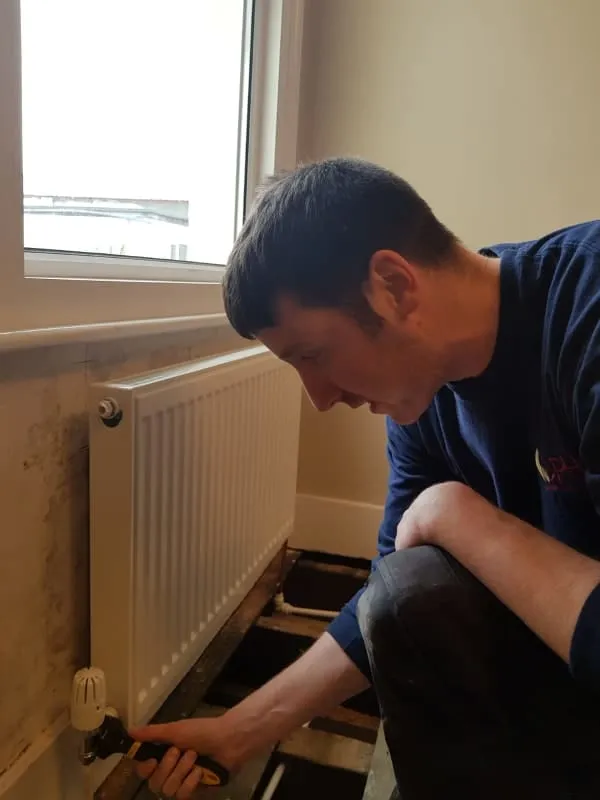
Thermostatic radiator valves, or TRVs, are the valves with numbered heads on the side of most radiators. They control the temperature of each room by letting less hot water into the radiator as the room warms up. The numbers are not degrees, a stuck TRV is often a two-minute fix, and the one room that should not have a TRV is the room with your main thermostat.
What the numbers on a TRV mean
The numbers on a TRV, usually from 1 to 5 with a frost symbol below 1, set the room temperature the valve aims for. They are not the temperature of the radiator and they are not a power setting.
Exact temperatures vary between makes, so check the manufacturer’s leaflet for yours. As a rough guide:
| Setting | Roughly | Good for |
|---|---|---|
| Frost symbol | Just above freezing | Rooms you are not using in winter |
| 1 | Cool | Hallways, unused rooms |
| 2 | Mild | Bedrooms, if you like them cool |
| 3 | Comfortable, around 20°C on many valves | Living rooms, kitchens |
| 4 | Warm | Bathrooms, rooms with older occupants |
| 5 | Fully open | Rarely needed |
A common mistake is turning a TRV to 5 to warm a room faster. It will not heat any faster. The radiator gets the same hot water either way. Setting 5 only means the valve stays open longer, so the room ends up hotter than you wanted.
How thermostatic radiator valves work
Inside the head is a wax or liquid capsule that expands as the room warms. As it expands, it pushes down on a small pin in the valve body. The pin closes the valve gradually, cutting the flow of hot water into the radiator. When the room cools, the capsule contracts, the pin springs back up and the flow increases again.
Because the head senses the air around it, a TRV works best when it is not hidden behind long curtains or furniture, and not boxed in by a radiator cover. If it is, it can think the room is warmer than it is and shut off too early.
Where not to fit a TRV
Do not fit a TRV on the radiator in the room with your main room thermostat. The two will fight each other. If the TRV shuts that radiator off before the room reaches the thermostat’s setting, the thermostat keeps calling for heat and the boiler keeps running for nothing. That radiator should have a manual valve or a lockshield at each end, or a TRV set fully open.
Your system also needs somewhere for water to go when every TRV closes. Most systems have an automatic bypass valve for this, and many modern boilers have one built in. If yours does not, an engineer may leave one radiator without a TRV. If your boiler or pipes are noisy when the house is warm, a missing or badly set bypass can be the reason.
The same rule applies to smart radiator valves. Our guide to smart thermostats covers how those fit in.
Radiator cold and the TRV won’t open? Freeing a stuck pin
TRVs often stick in summer. With the heating off for months, the pin seizes in the closed position, and in autumn one radiator stays cold. This is something you can usually fix safely yourself.
- Turn the heating off and let the radiator cool.
- Turn the TRV head to 5, fully open.
- Remove the head. Most unscrew with a large plastic collar or come off with a clip or a small grub screw. You do not need to drain anything. The water stays sealed in the valve body.
- Find the pin. It is a small metal pin sticking up from the middle of the valve body.
- Press it gently with the flat of a pair of pliers or the back of a screwdriver. It should push down and spring back up. If it is stuck down, grip it lightly with pliers and ease it up and down a few times until it moves freely.
- Do not force it or pull it out. If it will not move with gentle pressure, stop.
- Refit the head at setting 5, turn the heating on and check the radiator warms. Then set it to the number you want.
If the pin moves but the radiator is still cold at the top, it probably has air in it. See how to bleed a radiator. If it is cold at the bottom, sludge is more likely, and our guide to radiators cold at the top or bottom explains what to do.
Replacing a TRV
If the pin will not free, the valve body is leaking, or the head is broken, the TRV needs replacing. Replacing just the head is simple. Replacing the valve body means draining at least part of the system or freezing the pipe, then refilling, bleeding and re-dosing inhibitor. That is a job for an engineer.
Older radiators sometimes have no TRVs at all. Upgrading them is worth doing when other heating work is planned, such as a new boiler or a radiator replacement.
What is balancing, and why does it matter?
At the other end of each radiator from the TRV is the lockshield valve, usually under a plain plastic cap. It sets how much water that radiator gets compared with the others.
On an unbalanced system, radiators closest to the boiler take most of the hot water and get very hot, while ones further away, often upstairs or at the far end of the house, stay lukewarm. Balancing means adjusting the lockshield valves so every radiator gets its fair share. It is done with the heating running, using thermometers to check the temperature drop across each radiator.
It takes patience and the right tools. If you have a mix of hot and lukewarm radiators and bleeding has not helped, ask for it on your next central heating repair or service visit.
When to call an engineer
- The TRV pin will not move with gentle pressure
- The valve is leaking from the body or the pipe joint
- Some radiators are always hotter than others
- Your boiler or pipes are noisy when the rooms warm up
- You want TRVs fitted to radiators that do not have them
Call Lee on 020 8050 5913 if a radiator will not come on. If it is a stuck pin, he will usually talk you through freeing it over the phone for free. If a valve needs replacing, you can book through our radiators page.
Stuck? Call Lee.
If you are not sure it is safe, stop and call. Advice by phone is free.
020 8050 5913