How to prepare your heating for winter: a checklist
Prepare heating for winter with this simple checklist: book a service, check the pressure, bleed radiators, test early, protect pipes and fit a CO alarm.
The best way to prepare your heating for winter is to test it before you need it. Book a service, check the boiler pressure, bleed the radiators and run the heating for an hour on a mild day in early autumn. Most of the breakdowns we see on the first cold weekend of the year were sitting there all summer, waiting for someone to turn the heating on.
Here is the checklist Lee runs through with his own customers. Most of it takes minutes and needs no tools beyond a radiator key.
How to prepare your heating for winter: the checklist
| Task | DIY or engineer | When |
|---|---|---|
| Boiler service | Engineer | Early autumn, before the rush |
| Check boiler pressure | DIY | Now, then monthly |
| Bleed radiators | DIY | Now |
| Test the heating | DIY | A mild day in September or October |
| Check the condensate pipe | DIY | Before the first frost |
| Find your stopcock | DIY | Now |
| Lag exposed pipes | DIY or engineer | Before the first frost |
| Test or fit a CO alarm | DIY | Now |
1. Book a boiler service
An annual service is the single most useful thing you can do. A Gas Safe registered engineer checks the boiler is burning safely, cleans what needs cleaning, and spots worn parts before they fail on a cold night. Most manufacturers also make an annual service a condition of their warranty.
Book early. By the time the first cold snap arrives, every heating engineer in London is busy with breakdowns. You can book through our boiler servicing page.
2. Check the boiler pressure
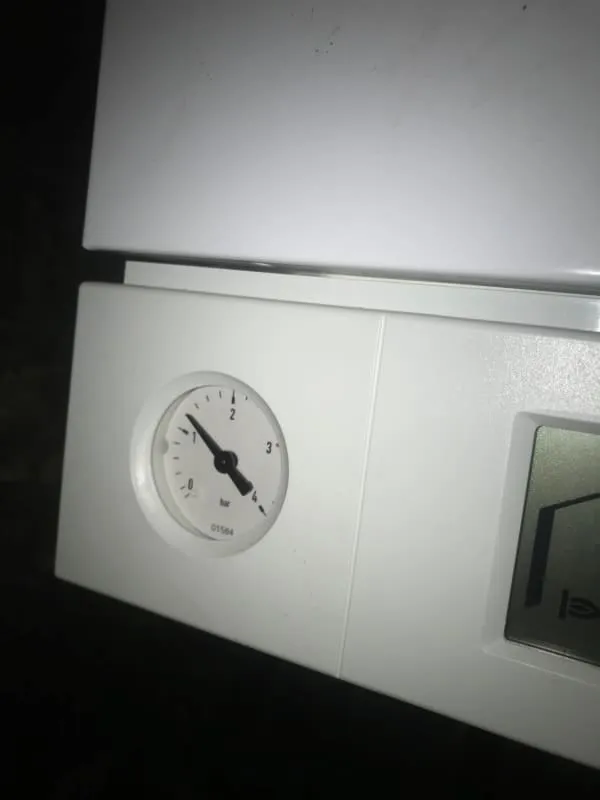
Find the pressure gauge on the front or underside of the boiler. With the heating off and cold, it should read between 1 and 1.5 bar.
- Below 1 bar: top it up. Our guide on how to repressurise a combi boiler walks you through it.
- Above 2.5 bar: do not add water. Call us.
If you find yourself topping up every few weeks, there is a leak somewhere, and it will get worse under the strain of winter use.
3. Bleed your radiators
Air collects in radiators over the summer. A radiator that is warm at the bottom and cold at the top has air in it.
- Turn the heating on and let the radiators get hot, then turn it off and let them cool slightly.
- Hold a cloth under the bleed valve at the top corner of the radiator.
- Turn the radiator key slowly anticlockwise, a quarter turn is usually enough. You will hear air hiss out.
- Close the valve as soon as water starts to come out.
- Do the rest of the radiators, then check the boiler pressure again. Bleeding lowers it, so you may need to top up.
If the water that comes out is black, your system has sludge, and it is worth mentioning at your service.
4. Test the heating early
Pick a mild day in September or October and turn the heating on for an hour. Turn the thermostat up so it definitely calls for heat. Check that:
- The boiler fires without a fault code
- Every radiator warms up, top to bottom
- There are no new noises, such as banging, gurgling or whistling
- You still get hot water at the taps while the heating is on
This is also the time to free any stuck radiator valves. If one radiator stays cold, the valve pin may have seized over the summer. Our guide to thermostatic radiator valves shows how to free it.
5. Check the condensate pipe
Modern condensing boilers drain water through a plastic pipe, often running outside to a drain. In freezing weather that pipe can freeze, and the boiler stops. Follow the pipe from the boiler and check where it goes. If a long section runs outside, ask about having it insulated or rerouted at your service. If it does freeze, our guide to a frozen condensate pipe shows how to thaw it safely with warm water.
6. Find your stopcock
If a pipe bursts, you need to turn off the water fast. Find your internal stopcock now, not when water is coming through the ceiling. It is usually under the kitchen sink, but it can be in a cupboard, under the stairs or under floorboards. Check it turns. If it is stiff, do not force it. A seized stopcock is worth having replaced before winter.
7. Lag exposed pipes
Pipes in lofts, garages, outside walls and under suspended floors are the ones that freeze. Foam pipe lagging from any DIY shop slips over them and is simple to fit. Pay attention to pipes near the loft hatch, near air bricks and anywhere a draught hits them. Outside taps should be isolated and drained, or fitted with an insulated cover.
If you go away in winter, leave the heating on low or on a frost setting rather than off.
8. Test or fit a carbon monoxide alarm
Carbon monoxide has no smell or colour. Every home with a gas boiler, fire or other fuel-burning appliance should have a working CO alarm, fitted in line with the maker’s instructions. Press the test button now, and check the expiry date on the back. Most have a limited life.
If the alarm sounds, open windows, turn off gas appliances if it is safe to do so, get everyone outside, and call the National Gas Emergency Service on 0800 111 999. More detail is in our guide to carbon monoxide signs and alarms.
When to call an engineer
- The boiler shows a fault code or will not fire when you test it
- Pressure keeps dropping after you top it up
- Radiators stay cold after bleeding and freeing the valves
- You smell gas. Leave the property and call 0800 111 999
- Your CO alarm sounds, or you notice soot or staining around the boiler
If your heating is not ready for winter, call Lee on 020 8050 5913 between 6am and 6pm, seven days a week. If he can talk you through a fix on the phone, there is no charge. If it has already let you down, we offer 24/7 emergency heating repair, 365 days a year.
Stuck? Call Lee.
If you are not sure it is safe, stop and call. Advice by phone is free.
020 8050 5913