Magnetic boiler filter: what it does and why it matters
A magnetic boiler filter catches the sludge that wears out boilers. Why one is fitted with every new boiler, how it is cleaned at a service and warranty rules.
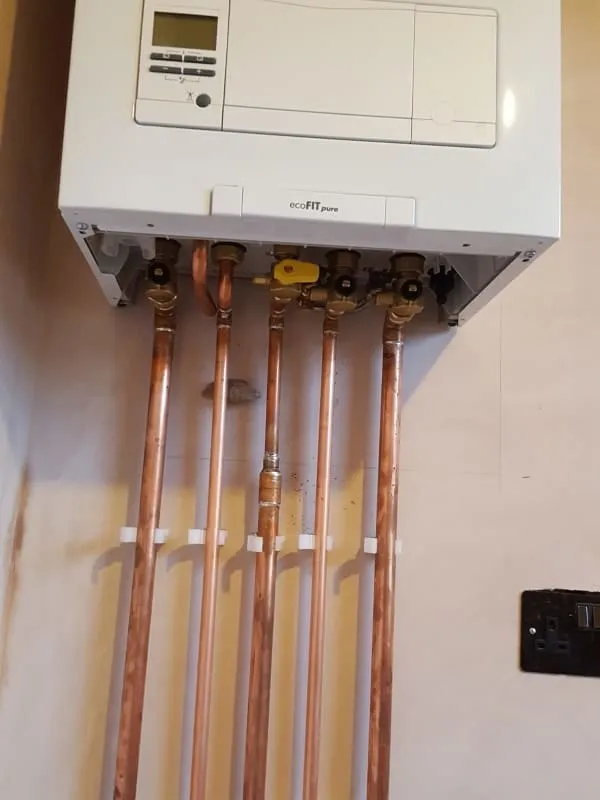
A magnetic boiler filter is a small canister fitted on the pipework under your boiler that pulls black sludge out of the heating water before it reaches the boiler. It is cheap compared with the parts it protects, it gets cleaned out at each annual service, and most boiler manufacturers expect one to be fitted if you want their full warranty.
If you have had a new boiler in the last few years, you probably already have one. It is usually the cylinder on the return pipe just below the boiler, often with a brand name such as Adey MagnaClean or Fernox on the side.
What a magnetic boiler filter does
Central heating water slowly corrodes the steel inside radiators and pipes. The result is magnetite, a fine black iron oxide sludge. It circulates round the system with the water, and because it is heavy it settles wherever the flow slows down: radiator bottoms, the pump and, worst of all, the narrow waterways of the boiler’s heat exchanger.
A magnetic filter sits on the return pipe, the pipe bringing water back from the radiators to the boiler. Inside is a strong magnet. As the water passes through, the magnetite sticks to the magnet and stays there instead of going into the boiler. Many filters also have a mesh or a chamber that slows the water so non-magnetic debris drops out too.
The filter does not stop corrosion happening. That is the job of the inhibitor chemical in the water. The filter catches what corrosion still produces, so it never builds up.
Why one is fitted with every new boiler
When we fit a new boiler, a magnetic filter goes in as standard. There are three good reasons.
- It protects the new heat exchanger. Even after a thorough clean, an older system keeps shedding some sludge for a while. The filter catches it before it reaches the new boiler.
- Manufacturers expect it. Most boiler makers set conditions for their warranty, and many make a filter a condition of their longer warranty periods. Without one, a sludge-related fault may not be covered. Our guide to the boiler warranty explains how these conditions work.
- It shows you what is going on. When the filter is opened at a service, the amount of sludge on the magnet tells the engineer how the system is doing. A clean magnet year after year is good news. A thick black coat means the inhibitor needs attention or the system needs a clean.
The filter goes in alongside cleaning the system and adding inhibitor. You can read more about that cleaning step, and when a full flush is needed, in is a power flush worth it.
Can you fit one to an existing boiler?
Yes. A magnetic filter can be added to almost any wet central heating system with a boiler, not just new installations. It is a sensible upgrade if:
- You have bled radiators and seen black water
- Radiators are cold at the bottom
- You have had a pump or heat exchanger replaced because of sludge
- Your system has just been power flushed and you want to keep it clean
Fitting a filter means cutting into the heating pipework, draining down part of the system and refilling and re-dosing inhibitor afterwards. It is a job for an engineer. It is usually done in a short visit, and it can often be done at the same time as a service. We charge by the hour, with the filter itself at cost plus 20%; see our prices page for the rates.
How the filter is cleaned at a service
Cleaning the filter is part of a proper annual service on a system that has one. The engineer will:
- Turn the boiler off and let the system cool.
- Close the isolating valves on either side of the filter so the rest of the system stays full.
- Release any pressure and open the filter, or remove the magnet sleeve, depending on the model.
- Wipe or rinse the sludge off the magnet and check the seals.
- Refit, open the valves, bleed out any air and check the pressure.
- Top up the inhibitor if needed, often dosed through the filter itself.
It only takes a few minutes, but it is worth having done every year. A filter that is never cleaned eventually fills up and stops catching anything. You can see what else should happen on a visit in what does a boiler service include.
Can I clean a magnetic filter myself?
Some filters are designed so a homeowner could clean them, and manufacturers publish instructions. In practice we suggest leaving it to the annual service. Opening the filter means isolating part of a pressurised system, and a seal that is not seated properly can leak. You will also usually need to top the boiler pressure back up afterwards. If you do have a go, follow the maker’s instructions exactly and keep an eye on the pressure gauge. If it drops, our guide on how to repressurise a combi boiler shows you how to top it up.
Never open the boiler casing itself. The filter sits outside the boiler on the pipework, and that is the only part you should touch.
Magnetic filter and hard water
London has hard water, so heating systems here also have to deal with limescale, mostly in the boiler’s hot water side on a combi. A magnetic filter does not stop limescale. That needs a separate scale reducer on the cold water feed to the boiler, which some manufacturers also require in hard water areas. We will tell you if your boiler needs one when we quote.
When to call an engineer
- Your filter is leaking from the lid or the valves
- The filter has never been cleaned, or you do not know when it last was
- You keep seeing black water when you bleed radiators, even with a filter fitted
- You want a filter added to an existing boiler
- Your boiler has had sludge-related repairs and you want to stop it happening again
Call Lee on 020 8050 5913 if you are not sure whether you have a filter or whether it needs attention. He is happy to talk it through. To have yours cleaned, book through our boiler servicing page, or ask for a filter as part of a free written quote for a new boiler.
Stuck? Call Lee.
If you are not sure it is safe, stop and call. Advice by phone is free.
020 8050 5913