Boiler losing pressure? Causes and safe checks
A boiler losing pressure has a leak, a faulty relief valve or a flat expansion vessel. Here is how to check each one safely and when to call an engineer.
If your boiler keeps losing pressure, water is leaving the heating system somewhere. The usual culprits are a small leak, a pressure relief valve that is letting water out, or an expansion vessel that has lost its charge, and a few of these you can check yourself in ten minutes.
A one-off drop after bleeding radiators is normal. A boiler losing pressure every few days or weeks is not, and topping it up again and again only hides the fault.
What pressure should a boiler be at?
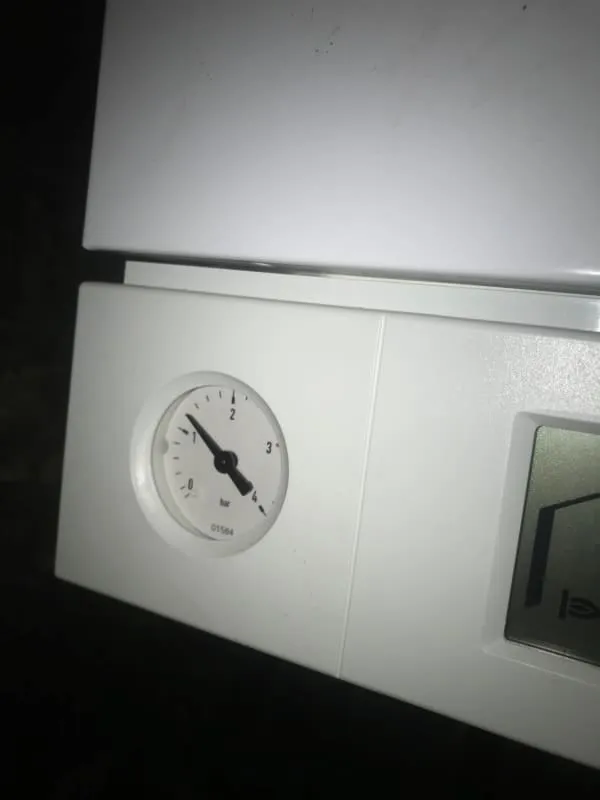
Most combi and system boilers like to sit at about 1 to 1.5 bar when the heating is cold. It will rise a little when the system is hot, often to around 2 bar. Below 1 bar many boilers stop and show a low pressure fault. Your boiler manual gives the exact figures for your model.
If yours has dropped, our guide on how to repressurise a combi boiler walks you through topping it up. Once it is back to the right level, use the checks below to find out why it fell.
Why is my boiler losing pressure?
There are four common reasons, and they leave different clues.
| Cause | Typical clue |
|---|---|
| Leak on a radiator, valve or pipe | Damp, drips, rust marks or green crust on fittings |
| Pressure relief valve letting by | Copper pipe outside is wet or dripping |
| Expansion vessel lost its charge | Pressure shoots up when hot, then falls when cold |
| Radiators recently bled | One drop straight after bleeding, then steady |
1. A leak somewhere in the system
Even a slow drip will pull the pressure down over a few days. Leaks are most common where things join: radiator valves, the nuts on the radiator tails, towel rail connections and the pipework under the boiler. Some leak onto a hot pipe and evaporate before you see a puddle, so look for white or green crusting, rust stains and warped skirting or flooring.
Pipes under floorboards or in walls can leak out of sight. A damp patch on a ceiling, a musty smell or a stain spreading across a wall are all worth taking seriously.
2. The pressure relief valve
Every sealed heating system has a pressure relief valve (PRV). If the pressure goes too high, it opens and dumps water through a copper pipe that usually runs outside, often poking out of the wall near the boiler. Valves can wear or get grit in the seat and keep letting a little water out long after they should have closed.
3. The expansion vessel
Water expands as it heats. The expansion vessel is a tank inside or next to the boiler with an air cushion that soaks up that extra volume. Over time the air charge leaks away. Then the pressure climbs sharply when the heating is on, the relief valve opens to let some out, and when the system cools the pressure is lower than before. The cycle repeats, so the pressure keeps creeping down.
4. You have just bled the radiators
Bleeding lets air out, and water from the system moves in to take its place, so the pressure drops. That is expected. Top it up once and it should hold. See our guide on how to bleed a radiator for the full method.
How to check each cause safely
You do not need tools for any of this, and none of it involves opening the boiler.
- Top up to 1 to 1.5 bar with the heating cold, then write down the reading.
- Turn the heating on for an hour and note the reading again. A rise of around half a bar is normal. If it races up towards 3 bar, the expansion vessel is the likely cause.
- Go outside and find the copper pipe that comes from the boiler side of the wall. If it is wet, dripping or has a white stain below it while the pressure is normal, the relief valve is probably letting by.
- Walk round every radiator and towel rail. Run a dry tissue around each valve and the nuts underneath. Any damp patch on the tissue points to the leak.
- Look under the boiler without removing any covers. Drips or staining on the pipes below are worth reporting to an engineer.
- Check the filling loop valves are fully closed. If one is slightly open, the pressure will usually rise rather than fall, which is a different problem but worth ruling out.
- Keep a simple log for a few days: date, time, reading, heating on or off. It helps an engineer pin the fault down quickly and saves you paying for time spent watching a gauge.
If you find a weeping radiator valve, a towel wrapped round it and a bowl underneath will do until it can be fixed. Do not try to tighten fittings on a pressurised system unless you are confident, as an overtightened nut can split.
Can I keep topping it up?
In the short term, yes. As a habit, no. Every top-up brings fresh water and oxygen into the system, which speeds up corrosion and sludge, and London’s hard water adds limescale too. If you are refilling more than once every few weeks, get the cause found and fixed. It is usually a cheaper job than the damage it leads to.
When to call an engineer
Call us when:
- The pressure drops again within a few days or weeks
- The pressure goes above 2.5 bar or the relief pipe outside is dripping
- You can see water coming from inside the boiler casing
- You suspect a hidden leak under a floor or in a wall
- The boiler shows a fault code you do not recognise
Expansion vessels, relief valves and anything inside the boiler must be handled by a Gas Safe registered engineer. Never remove the boiler casing yourself. If you smell gas, leave the property and call the National Gas Emergency Service on 0800 111 999.
For hidden leaks, our leak detection service traces the source before anything is lifted. For faults at the boiler, book a boiler repair. Our labour rates are on the prices page.
Lee answers the phone himself on 020 8050 5913, seven days a week from 6am to 6pm, and if he can talk you through a fix there is no charge. We cover homes across South and South West London and north Surrey, from Battersea to Wimbledon.
Stuck? Call Lee.
If you are not sure it is safe, stop and call. Advice by phone is free.
020 8050 5913